R134a Freon AC Repair
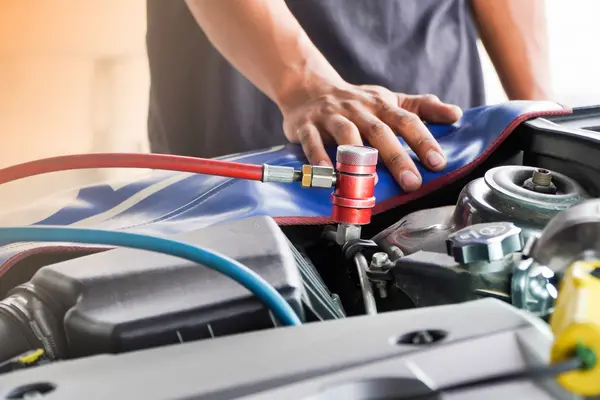
How do my car's air conditioning and heating systems work?
We take advantage of the fact that we can stay warm in our cars during Mechanic Falls, ME winters and cool during Hebron, ME summers, but our vehicles' air conditioning and heating systems are fairly complex. To heat up your car, hot engine coolant is circulated through a small radiator, which is often called a heater core. There is a fan in front of the heater core to blow cool air to blow cold outside air over the fins. As this air travels through the heater core, it heats up, and this is the warm air that blows out of your heater vents.
Your vehicle's air conditioning system includes the condenser, compressor, expansion valve, and evaporator. Refrigerant or coolant is compressed in the compressor and turns into a hot gas. This hot gas is cooled into a liquid state in the condenser, then travels to the expansion valve. In the expansion valve, the refrigerant turns back into a gas and rapidly cools in the evaporator. A fan blows over the evaporator and cools the air that blows out of your vents. If any parts of your vehicle's heating or air conditioning systems are damaged, it can affect the entire system. If you sense a problem, feel free to bring your car or truck to Economy Auto Service in Androscoggin today.
The Problem with R12
In order for refrigerant to work effectively, the liquid needs to have a low boiling point and should be in a gaseous state at room temperature and easily pressurized as a liquid, so it can boil at room temperature and then cool in the evaporator. In the early 1930s, a refrigerant called chlorofluorocarbon (CFC) was developed and was given the name R12 or Freon. Although R12 met all the requirements for a refrigerant as stated earlier, it was found to be significantly reducing the Earth's ozone layer. Starting in 1987, the use of R12 began to be phased out and was completely gone by 1994.
Welcoming R134a
Automotive manufacturers started using tetrafluoromethane, or R134a (which also went by the name Freon), a refrigerant that does not have the ozone-destroying properties of R12. However, with this transition, there came a lubricant issue. Air conditioning compressors require oil because they are consistently moving. The oil has to dissolve into the refrigerant and therefore, must be compatible with the refrigerant. Because of this, R134a manufacturers began selling Polyalkylene Glycol, or PAG Oil. Today, R134a is used in many vehicles' air conditioning systems, including in Ford, Jeep, Honda, and GMC vehicles.
A/C Diagnostics: R-134a and R-1234yf Systems
A/C diagnostics are used to confirm the system is sealed, properly charged, and capable of cooling before repairs or refrigerants are added. A typical R-134a diagnosis takes about 45 minutes to 1.5 hours, while an R-1234yf diagnosis may take 90 to 180 minutes because it requires refrigerant identification, stricter recovery procedures, and contamination checks.
Basic Diagnostic Process
- Visual inspection: Check the drive belt, compressor clutch operation, hoses, fittings, condenser, compressor, and signs of oily residue.
- Leak and vacuum testing: Pressure-test with dry nitrogen when needed, then pull vacuum for 30 to 45 minutes. A vacuum loss indicates a leak.
- Gauge and temperature checks: Compare high- and low-side pressures to ambient temperature and verify vent temperature. Abnormal pressures may indicate low charge, overcharge, restriction, or airflow problems.
- Dye or electronic leak detection: Use UV dye or an approved leak detector to locate slow leaks at hoses, seals, condenser, evaporator, and compressor areas.
R-1234yf Additional Requirements
- Identify refrigerant purity before recovery to prevent cross-contamination.
- Recover refrigerant with an approved R-1234yf machine and record the amount removed.
- Recharge only by exact factory weight and use the correct oil, especially on EV or hybrid systems.
- Perform final verification with gauge readings and vent-temperature testing.
Why Pay for Diagnostics?
Online answers, videos, and quick guesses can point in the right direction, but they can also be wrong and cost money. Two vehicles can have the same symptoms or codes and still need different repairs. Professional diagnostics use provable steps—visual inspection, scan data, pressure readings, electrical testing, leak testing, road testing, and trained experience—to pinpoint the actual concern instead of guessing.
The goal is not to sell unnecessary parts; it is to test the system correctly, protect the customer’s money, and recommend the repair that matches the vehicle’s actual failure.
Your Quality Shop for R134a Freon AC Repair
Here at Economy Auto Service in Mechanic Falls, ME, 04256, we are experts in all things auto repair and can repair your R134a Freon AC efficiently and cost-effectively.
We've been fixing cars since 2014, and we prioritize top-quality customer service above all else. Our mission is to exceed your expectations by earning your trust and providing the most reliable, honest, and courteous service available in the market today. We have a review score of 100 based on reviews from 182 satisfied customers. If you are in Mechanic Falls, Hebron, ME, Paris, ME, Minot, ME, Oxford, ME, or surrounding areas, feel free to call us at 207-346-3701 or go online to schedule an appointment!





We are a Digital Shop
The Economy Auto Service technicians use the latest technology to not only tell you if there are any issues with your vehicle, but show you. If we uncover an issue the photo will be e-mailed to you for your records. At the end of every visit you will receive a detailed report regarding the general health of your vehicle. Our #1 goal is to keep you safe on the road.
Read more